NetSuite in 2026: Top Trends Shaping ERP, AI, and Business Growth
OpenTeQ Admin | Updated: Jan 22,2026
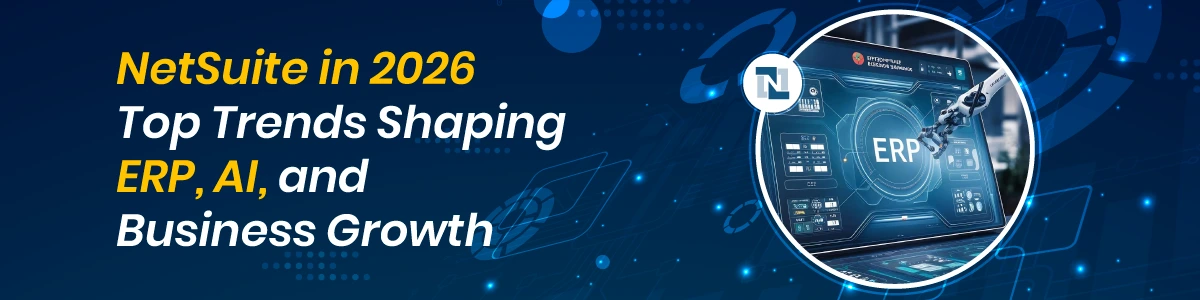
Enterprise Resource Planning (ERP) is undergoing a fundamental shift. As organizations prepare for 2026, NetSuite is no longer viewed as just a financial system—it’s becoming a strategic platform that connects data, automation, and intelligence to drive business growth./p>
From AI-powered decision-making to composable architectures and industry-specific workflows, NetSuite is evolving to meet the demands of modern enterprises operating in fast-changing markets.
Here are the key trends shaping NetSuite, ERP strategy, and business growth in 2026.
1. AI and Agentic Automation Become Core to ERP
Artificial Intelligence is moving beyond dashboards and insights. In 2026, NetSuite environments increasingly leverage agentic AI—systems that can act, automate, and optimize processes autonomously.
Use cases include:
- Automated journal entries and reconciliations
- Predictive cash flow and demand forecasting
- Intelligent exception handling in procure-to-pay and order-to-cash
This shift allows finance and operations teams to focus less on manual execution and more on strategic planning.
2. Cloud-First and Composable ERP Architectures
Cloud-native ERP is now the default, and NetSuite continues to lead with flexible, scalable deployments. Enterprises are adopting composable architectures, integrating best-of-breed tools without heavy customization.
This approach enables:
- Faster innovation cycles
- Easier upgrades and integrations
- Reduced long-term technical debt
Composable ERP ensures NetSuite can evolve alongside business needs without disruption.
3. Predictive Analytics and Real-Time Insights
In 2026, ERP success is defined by how quickly organizations can act on data. NetSuite is increasingly used as a real-time intelligence hub, combining operational, financial, and customer data.
Advanced analytics enable:
- Scenario modeling and forecasting
- Performance tracking across subsidiaries
- Proactive risk identification
This data-driven foundation helps leaders make confident decisions in dynamic environments.
Where ERP, AI, and growth strategy converge

4. Industry-Specific NetSuite Solutions
Generic ERP implementations are giving way to industry-tailored workflows. NetSuite’s industry accelerators and preconfigured modules reduce implementation time while improving adoption.
Industries leading this shift include:
- Manufacturing
- Healthcare and life sciences
- Retail and e-commerce
- Financial services
Industry alignment ensures ERP supports real-world processes—not just system requirements.
5. Two-Tier ERP Strategies Gain Momentum
Global organizations are increasingly adopting two-tier ERP models, using NetSuite for subsidiaries while maintaining a Tier-1 ERP at headquarters.
This strategy offers:
- Faster rollouts for new entities
- Lower costs for regional operations
- Standardized reporting across the enterprise
NetSuite’s flexibility makes it an ideal platform for scaling multi-entity operations.
6. Security, Governance, and Compliance by Design
As ERP systems become more autonomous, security and governance are moving to the forefront. In 2026, NetSuite implementations emphasize:
- AI governance and audit readiness
- Role-based access and compliance controls
- Continuous monitoring and risk management
Security is no longer an add-on—it’s embedded into ERP strategy from day one
Conclusion
NetSuite in 2026 represents a shift from transactional ERP to intelligent, growth-enabling platforms. Organizations that align AI, analytics, cloud architecture, and industry-specific workflows will gain measurable efficiency and competitive advantage.
ERP is no longer just a system of record—it’s a strategic engine for business growth.
NetSuite in 2026: Smarter systems. Faster decisions. Stronger growth.
Contact OpenTeQ Technologies Today!
Recent Posts
-
 NetSuite ERP Software for Manufacturing Companies: A Complete Guide to Streamlining Operations
Sep 22,2026
-
 Why Construction Companies Are Choosing NetSuite ERP in 2026
Sep 1,2026
-
 Certified NetSuite Consultants vs Freelancers: Which Is Better
Aug 25,2026
-
 A Complete Guide to NetSuite Application Development
Aug 18,2026
-
 Top Benefits of NetSuite Mobile Apps for Modern Businesses
Jul 27,2026
-
 What Is a NetSuite Vendor Portal and How Does It Improve Supplier Management
Jul 20,2026